What You Need to Know as Your Parents Get Older
David Solie's 89-year-old mother, Ballad, was unyielding. "No, I volition non move," she told her son every fourth dimension he suggested that she leave her home and relocate to a senior living residence.
And information technology didn't stop there. Although Carol suffered from coronary artery disease, severe osteoporosis, spinal compression fractures and unsteady residual, she didn't want help. When Solie brought in aides to help after a bad fall and subsequent surgery, his mother fired them in a matter of days.
"In her mind, she considered information technology a disgrace to have everyone in her dwelling,"
Solie said. "This was her domain for over 50 years, a place where she did everything past herself and in her ain way."
Conflicts of this sort often threaten relationships between aging parents and their developed children merely when understanding and back up are needed the most. Instead of working together to solve problems, families notice themselves feuding and riven past feelings of resentment and distress.
Solie got so worked up, he considered going to court and asking for a conservatorship ― a legal organization that would have given him control over his mother'south affairs. (The situation was complicated considering Solie'south blood brother, who has Down's syndrome, lived at the family home.) But Solie'southward lawyer advised that this grade of activity would destroy his relationship with his mother.
Today, Solie, a health care consultant and writer with a well-regarded blog well-nigh crumbling, sounds the aforementioned theme when he consults with adult children caring for parents. Make preserving trust and keeping your human relationship intact ― not winning arguments ― a priority, he suggests. What your parents nearly need is confidence that you'll listen to them, accept their concerns seriously and stay by their side no matter what happens, he says.
How adult children communicate with parents can go a long way toward easing tensions, Solie says. Instead of telling your parent what to do, ask how they'd prefer to solve problems. Arm-twist their priorities and recognize their values when making suggestions. Give them choices whenever possible. Exist attuned to their unexpressed needs and fears.
When Dr. Lee Lindquist, chief of geriatrics at Northwestern University'southward Feinberg School of Medicine, asked 68 older adults in eight focus groups why they resisted aid, the answers varied. They said they were agape of losing their independence, becoming a burden on loved ones, being taken advantage of and relinquishing control over their lives.
Asked what might make a difference, the older adults said they liked the idea of "interdependence" ― acknowledging that people need one another from childhood to older age. And they constitute it helpful to think that "by accepting assist, they were in turn helping the person providing the help," according to Lindquist's study, published last year in the Journal of the American Elderliness Society.
Unfortunately, no amount of patience, compassion or forbearance volition piece of work in some conflict-ridden circumstances. Only here's some of what experts accept learned:
Be patient. Give your parents fourth dimension to adjust. At showtime, Jane Wolf Frances' 87-year-old mother, Lillian Wolf, wouldn't consider moving with Jane's begetter from New York Metropolis to the Los Angeles area, where Frances, her but child, lived.
Although Lillian had Alzheimer's disease and Frances had planned to give her ane-story house to her parents, "I deferred to my mother'south fear that she was going to be losing something essential," she said.
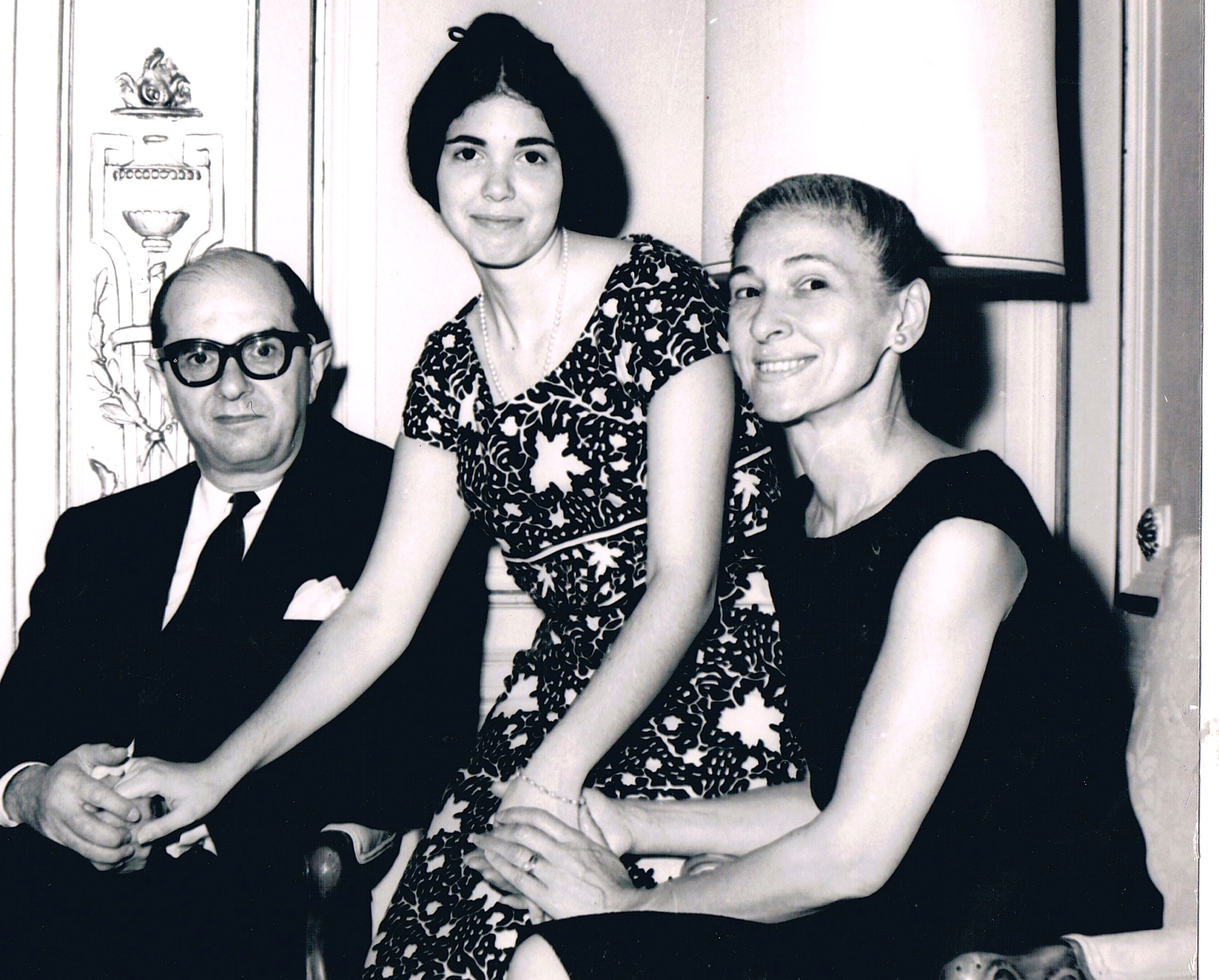
Jane Wolf Frances (center) with her parents, Jack and Lillian Wolf, in 1963(Courtesy of Jane Wolf Frances)
During iii years of caregiving, Frances had learned to non rush her parents. She knew they had slowed downwardly and needed time to process change.
So Frances waited until her parent's dwelling house wellness aide called with concerns about their ability to live independently. Afterwards discussing the situation with their medico, Frances approached her mother once again. A move to assisted living would be a fresh start, allowing the family to spend more time together, she said. After several conversations, her female parent finally agreed.
Frances, a psychologist, is the author of a new volume, "Parenting Our Parents: Transforming the Challenge Into a Journey of Love" and founder of www.parentingourparents.org. Stay calm when disagreements arise with your elderly parents and tamp down your emotional reactions, she tells families. Listen advisedly to your parents' concerns and let them know you're trying to help them accomplish their goals, not impose your agenda.
"Information technology's often helpful to say to your parents 'I'k doing this for you; I'd like you to practise something for me,'" Frances said. "People who are good parents perk upward on that i and will inquire, 'OK, what tin I do for yous?' Then, you can tell them, 'You tin let me help yous more than.'"
Let them know you're on their side. Denise Brown was convinced her parents, Roger and Sally Loeffler, were making a terrible conclusion. In the previous year, Roger, 84, had been diagnosed with bladder and prostate cancer and undergone extensive surgery. Emerge, 81, had suffered three internal bleeds and had ane-third of her stomach removed.
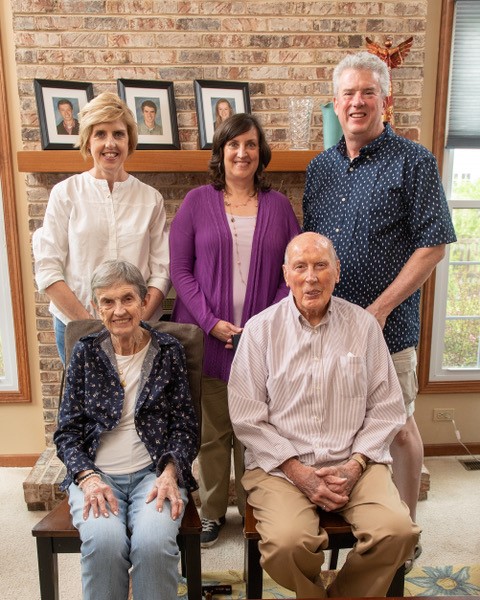
Denise Brownish (middle) with her siblings and parents, Sally and Roger Loeffler(Courtesy of Denise Chocolate-brown)
Brownish didn't think they could live on their own anymore, and her parents had moved into a retirement customs upon her recommendation. Just then, at a family meeting, her mother stood up and said, "I'm not dying in this dump. I detest it here." Equally Brown and her siblings turned to their father, he said, "I'll do whatever your mom wants."
When her parents decided to motility to an apartment, Chocolate-brown was confrontational. "I raised my vocalization and said, 'This is not skilful, this is terrible,'" she said. "They were shocked, but they said 'It doesn't matter; this is what we're going to do.'"
As Brownish thought about her reaction, she realized she thought her parents would be safer and have a more than "gentle" decease in the retirement community: "And so it occurred to me ― this wasn't what my parents wanted. They valued their independence. It's their conclusion nearly how the end of life plays out."
Brown allow her parents know she'd respect their wishes but would need to set limits. Her work ― Brown is the founder of http://www.CareGiving.com ― had to be a priority, and her parents would need to adapt other assist if she couldn't be available. (Brown'south ii brothers and sis help out.) And they'd have to be willing to talk openly almost how their choices were affecting her.
What doesn't piece of work: trying to communicate when whatsoever one of them is tired or angry. "We never get anywhere," Brown said. "Everybody gets defensive and shuts downward."
What does work: "asking them questions like how do you think we should try to solve this problem? It's interesting to hear their answers, and it makes working together and then much easier."
Stop expecting your parents to exist as they used to be. After her father's death, Loi Eberle was distraught when her mother, Lucille Miller, became involved with a man she and her siblings didn't like. With his encouragement, Miller invested in real manor and lost a great deal of money.
But nothing Eberle or her siblings said could convince her female parent that this relationship was subversive.
Eberle struggled with resentment and anger as her mother's needs escalated after a heart assault and a diagnosis of myasthenia gravis, a severe neurological disease. "Mom and I had this love/hate human relationship all my life, and in that location was a huge need for healing in this human relationship," she said.

Loi Eberle and her mother, Lucille Miller, in 2012(Courtesy of Loi Eberle)
In 2012, Eberle moved Miller, then 89, from her longtime dwelling in Minneapolis to a nursing abode in northern Idaho, most where Eberle lives. Gradually, she realized that her mother "had transitioned to existence someone else" ― someone who was vulnerable and at her life's end.
"I retrieve for a long fourth dimension I had this thought that I was going to help Mom come up back to who she was, and I spent a lot of time trying to do that," Eberle said. "I finally had to forgive myself for failure and sympathise that this is the life procedure."
With this shift in perspective, emotional tension dissipated. "When I'd visit, my female parent was ever and then happy to encounter me," Eberle said. Miller died in March 2017 at age 94.
Letting go of unrealistic expectations can defuse conflicts. This is the concluding phase of your journey with your parents. Effort to put malaise to 1 side and help make this fourth dimension meaningful for them and for you. Near of all, your parents desire to feel emotionally connected and accepted, even in a macerated country.
We're eager to hear from readers about questions you'd like answered, problems y'all've been having with your care and communication you need in dealing with the health care system. Visit khn.org/columnists to submit your requests or tips.
Source: https://khn.org/news/parenting-your-aging-parents-when-they-dont-want-help/

Post a Comment for "What You Need to Know as Your Parents Get Older"